How to optimize for AI search means structuring your content so generative AI engines — ChatGPT, Google AI Overviews, Perplexity, and Gemini — can cleanly extract, cite, and recommend your answers.
This 10-step playbook covers the technical setup (schema markup, structured Q&A, content freshness), the authority signals AI engines weigh most heavily (statistics, third-party citations, brand mentions), and the metrics that actually matter for small businesses in 2026.
The web, as we’ve seen over the past few decades, is in a constant state of flux. The Avita Group partners are (sadly) old enough to recall the beginning days of digital marketing on platforms like AOL and Lycos. As the evolution of the online experience grew with the likes of Yahoo, Google, etc., it was at a reasonable pace.
With the recent advent of AI popularity in the last 20 months, the pace of growth online has dramatically accelerated.
Search has changed faster in the last 18 months than in the previous decade. If your traffic strategy still ends at “rank in the top 3,” you’re missing the half of search that now happens inside AI-generated answers.
This guide is the practical, no-fluff playbook for getting cited by the AI engines your customers are already using.
Click the Play Button below to hear an enlightening podcast on the subject of AI search optimization strategies.
What Is AI Search Optimization?
AI search optimization (or AIO) is the practice of structuring your website, content, and digital footprint so that generative AI engines cite or summarize your content when answering user questions.
It overlaps with traditional SEO but plays by different rules. Where classic SEO is about ranking ten blue links, AI search is about being one of roughly 12 to 13 sources an AI engine pulls into a single answer. The goal isn’t just position #1 — it’s being citable, extractable, and trustworthy enough that an AI engine pulls your content into its response.
Most small businesses are already getting cited by AI engines without knowing it. The question is whether you’re showing up consistently, accurately, and for the queries that actually drive revenue.
AI Search Has Already Reshaped Click Behavior
The shift isn’t a forecast — it’s measurable. Here’s what the 2026 data actually shows:
- AI coverage rates nearly doubled from 23% in September 2025 to 47% in January 2026.
- The presence of an AI Overview reduces click-through rate to the top ranking content by 34%.
- ChatGPT processes about 2 billion queries per day across 883 million monthly users.
- AI search traffic converts at 3x the rate of other traffic.
If you’re a small business that depended on showing up in the top three organic results, the math has changed. Less raw traffic per ranking, but each AI-driven visitor is dramatically more likely to convert.
SEO vs AEO vs GEO: What’s Actually Different
Most articles use these three terms interchangeably. They’re distinct disciplines with different signals and success metrics:
| Discipline | What It Optimizes For | Primary Signals | Success Metric |
| SEO (Search Engine Optimization) | Ranking the 10 blue links on Google | Backlinks, keyword targeting, page speed, on-page optimization | Position 1–10 organic rankings, organic clicks |
| AEO (Answer Engine Optimization) | Being chosen as the answer in AI Overviews and featured snippets | Clear question/answer structure, schema markup, brand authority, source credibility | Citations in AI Overviews, snippet wins |
| GEO (Generative Engine Optimization) | Being cited across all generative AI engines (ChatGPT, Perplexity, Gemini, Claude) | Statistical content, original data, third-party brand mentions, presence on Wikipedia, Reddit, G2 | Brand mentions, citation share across AI platforms |
The practical takeaway for small businesses: in 2026, you need all three layers. SEO drives the organic clicks that still happen, AEO captures snippet and AI Overview real estate, and GEO ensures you’re recommended when buyers ask AI directly: “What’s the best [service] in [my city]?” If you only invest in one, you’re leaving the other two channels open for competitors.
In working closely with our clients at Avita Group, we’ve been hyper-focused on AI and geo-optimization over the past year and a half. In one case of an IT support company based in Los Angeles that has been a client of ours for over five years, the shift from simple SEO organic growth to featured citations on the major AI platforms has been a true revelation and success for their lead generation.
By incorporating many of the strategic ideas that we’ve put together in this article, that company has seen its monthly lead gen grow by double digits year over year.
How to Optimize for AI Search With a Small Business
So, here are the steps to accomplish what we’ve been able to sequenced from highest leverage to lowest. Start at the top.
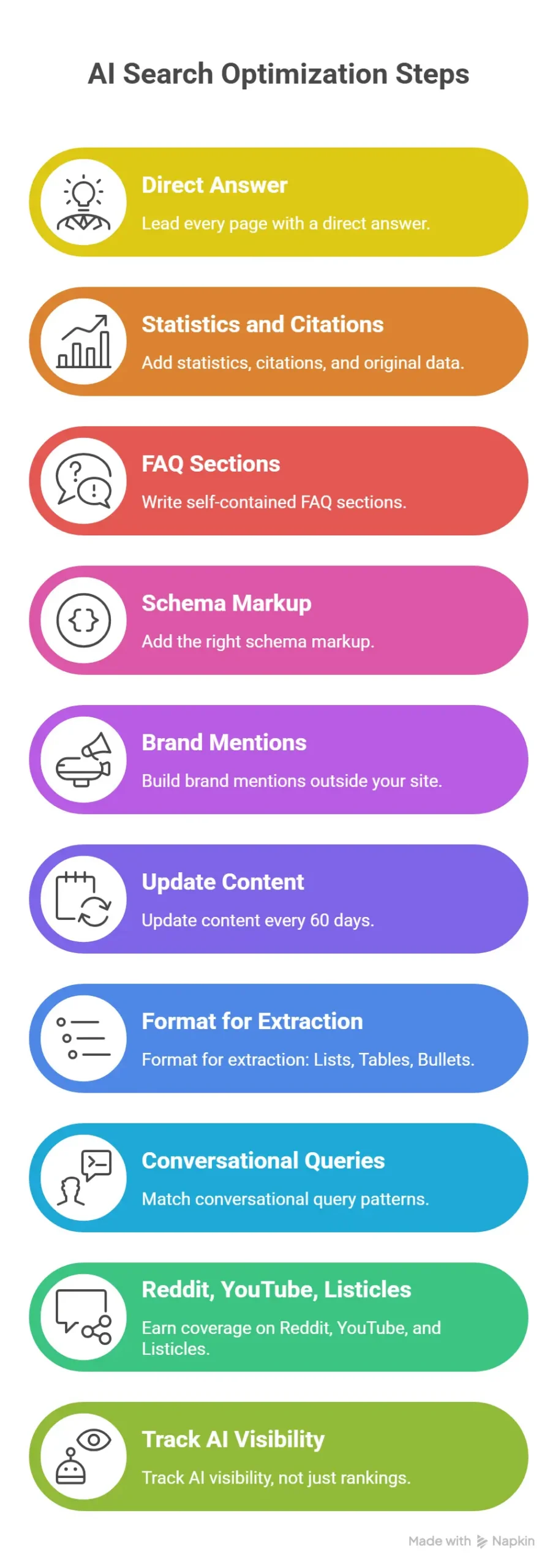
Step 1. Lead Every Page With a Direct Answer
Open with a 40 to 80 word summary that directly answers the page’s core question, with the primary keyword in the first sentence. AI models extract opening paragraphs disproportionately. If your first 100 words don’t contain a clean, quotable answer, you’re functionally invisible to AI engines.
Step 2. Add Statistics, Citations, and Original Data
This is the single biggest predictor of AI citation visibility. Pages with cited statistics earn 30-40% more AI mentions. Include verified numbers — survey results, internal data, industry benchmarks — and link them to authoritative sources. Original data (your own surveys, client results, internal benchmarks) earns even more weight.
Step 3. Write Self-Contained FAQ Sections
AI engines love structured Q&A. Each answer should be two to three sentences and read perfectly on its own — no “see the section above” or “click here for more.” If an AI extracts just the answer, it must still make complete sense in isolation.
Step 4. Add the Right Schema Markup
Implement Article, FAQ, Breadcrumbs, and Organization schema on every blog post. AI engines cross-reference structured data to verify content meaning.
The good news is you don’t have to be an expert coder to create schema code. When your article is finished, simply cut and paste the entire text into any AI platform and ask it to come up with the schema codes that we’ve referenced above. Then cut and paste that code into your website’s backend for that page.
Now keep in mind that if you’re using WordPress and have the Yoast plugin activated, most likely Yoast is automatically creating a lot of the schema for you. There may be nothing to do here. Check with your web designer or programmer to ensure exactly what schemas are being generated for every new page and every new blog post. Often times, article schema, breadcrumb schema, and organization schema are automatically generated. Manually generating and pasting into the page would create a duplicate schema issue that would actually work against you.
When the article is published, cut and paste the URL into a free schema validator tool to make sure that those schema codes are showing up for the AI and SEO engines.
Step 5. Build Brand Mentions Outside Your Site
AI engines weight brand authority signals heavily. Wikipedia is the most-cited source in ChatGPT (7.8% of all citations), followed by Reddit (1.8%), Forbes (1.1%), and G2 (1.1%). Earn mentions on Reddit (industry-relevant subreddits), trade publications, podcasts, and listicles. Backlinks help, but unlinked brand mentions count too.
Step 6. Update Content Every 60 Days
Pages updated within the last two months earn nearly 30% more AI citations than older content. Audit your top pages quarterly and refresh with new data, examples, sections, or expanded FAQs. Don’t republish for the sake of it — substantive updates only.
Step 7. Format for Extraction: Lists, Tables, Bullets
AI models pull cleanly from structured formats. A comparison table beats a paragraph. A numbered list beats a wall of text. Every long-form post should include at least one table, one numbered list, and one comparison structure.
Step 8. Match Conversational Query Patterns
Searches that trigger AI Overviews tend to be longer. Optimize for full-question phrases like “how do I optimize for AI search,” “what’s the best free directory for my industry,” or “is AEO replacing SEO.” These conversational long-tails are the new keyword targets.
Step 9. Earn Coverage on Reddit, YouTube, and Listicles
These are AI engines’ favorite sources. Reddit alone accounts for roughly 21% of Google AI Overview citations, with YouTube at 19%. A genuine, helpful Reddit presence in your industry’s subreddits, plus YouTube content (even short tutorials), earns AI visibility that backlinks alone can’t replicate.
Step 10. Track AI Visibility, Not Just Rankings
Traditional rank tracking misses 80% of the picture in 2026. Use tools like Ahrefs Brand Radar, Profound, or Superlines to track how often your brand is cited across ChatGPT, Perplexity, Gemini, and Google AI Overviews. Set up a monthly tracking cadence — AI visibility moves faster than organic SEO.
Where AI Engines Actually Pull Their Citations From
Knowing where AI engines source from tells you where to invest your effort:
| AI Platform | Top Citation Sources |
| ChatGPT | Wikipedia, Reddit, Forbes, G2 |
| Google AI Overviews | Reddit, YouTube, Wikipedia, Quora |
| Perplexity | YouTube, Wikipedia, Apple, Google |
| Google AI Mode | Wikipedia, YouTube, Google’s own blog, Reddit |
The pattern is consistent across platforms: user-generated content (Reddit, YouTube, Quora) and trusted reference sites (Wikipedia, G2, Forbes) dominate.
If your brand isn’t visible on at least two or three of these external surfaces, AI engines have no foundation on which to cite you.
For most small businesses, the highest-leverage off-site moves are: (1) a credible Wikipedia mention if eligible, (2) authentic Reddit presence in two or three industry subreddits, and (3) being listed and reviewed on industry-specific platforms like G2, Capterra, or trade-specific directories.
Speaking of which, if you haven’t claimed your business on the major free online business directories yet, that’s a foundational step that compounds with everything else in this playbook.
How to Measure AI Search Performance
Three metrics actually matter in 2026:
- AI citation rate — how often your brand appears in AI-generated answers across ChatGPT, Perplexity, Gemini, and Google AI Overviews. Track monthly.
- AI referral traffic — visits showing referrer domains like chatgpt.com, perplexity.ai, or AI-attributed sources in GA4. Set up custom segments.
- AI conversion rate — whether AI-driven traffic is more valuable per visit than your other channels. The benchmark is 14.2%. If your AI traffic converts below that, your landing pages need work.
Set up a monthly tracking cadence. AI visibility moves faster than organic SEO — what works in May 2026 may shift by August 2026, so the brands that win are the ones tracking and iterating most consistently.

The process of optimizing for AI search is no longer an option; it is a necessity if you want your small or medium business to stand out amongst its competitors.
Common Mistakes That Kill AI Search Visibility
- Burying the answer. If a reader has to scroll to find your point, AI extraction won’t either. Lead with the answer.
- Unsourced claims. “Many businesses say…” gets ignored by AI engines. “63% of businesses report [fact], according to [source]” gets cited.
- No structured data. Without schema markup, you’re forcing AI to guess what your page is about — and it often guesses wrong.
- Stale content. Pages older than 12 months earn dramatically fewer AI citations. Refresh top performers quarterly.
- No brand presence on Wikipedia, Reddit, or G2. AI cites trusted external sources first. Off-site presence isn’t optional in 2026.
- Treating AEO and GEO as separate from SEO. They aren’t separate programs — they’re integrated layers on top of solid search engine optimization fundamentals.
Where to Start
The brands winning AI search in 2026 are not the ones publishing the most content — they are the ones publishing the most extractable content.
Audit your highest-traffic pages with this playbook, prioritize the top three changes you can make this month (start with summary openers, FAQ structure, and schema markup), and measure citations monthly.
If you would rather have a team handle the audit, structural changes, and ongoing tracking, that’s exactly what Avita Group’s AI optimization services deliver. With over 30 years of experience in the digital marketing industry, Avita Group is built specifically for small businesses navigating the shift from traditional SEO to AI-driven discovery.
We also publish a deeper breakdown of how AI is changing digital marketing if you want broader context before diving in.
The fundamentals haven’t disappeared — they’ve expanded. Get the layers right, measure consistently, and your business shows up where buyers are now actually looking. And be sure to always keep reminding yourself that AI is your friend. Embrace its power.
Frequently Asked Questions on How to Optimize for AI Search
Is AI search optimization replacing traditional SEO?
No, it’s expanding it. The fundamentals of SEO — quality content, technical performance, backlinks — still drive both organic rankings and AI citations. About 76% of URLs cited in Google AI Overviews also rank in Google’s top 10. AI search optimization adds new layers (schema for extraction, brand mentions for authority, structured answers for citation) on top of traditional SEO, not in place of it.
How long does it take to see results from AI search optimization?
Most small businesses begin seeing AI citations within 30 to 60 days of publishing optimized content, faster than traditional SEO’s 3 to 6 month timeline. AI engines re-crawl and re-index more aggressively than traditional search, especially for pages with structured data and clear question-answer formats.
Do I need a separate AEO or GEO strategy from my SEO strategy?
Not as a separate program, but as integrated layers within your SEO strategy. The same article can target a Google ranking, an AI Overview citation, and a ChatGPT mention if it is structured correctly. The shift is in execution: write for extraction, cite sources, add schema markup, and earn third-party mentions.
How do I get my business cited by ChatGPT specifically?
ChatGPT favors Wikipedia, Reddit, Forbes, G2, Business Insider, and Amazon as top citation sources. To increase ChatGPT visibility, get your brand mentioned on these platforms, publish content with original statistics that other sites will cite, and ensure your homepage has a clear, factual “About” section with Organization schema markup.
Does schema markup actually help with AI search?
Yes. Schema markup, especially Article, FAQ, and Organization types, is one of the strongest signals AI engines use to understand page meaning. It is not a ranking factor in the traditional sense, but it dramatically improves extraction accuracy, and therefore citation likelihood.
What is the difference between AEO and GEO?
AEO (Answer Engine Optimization) focuses on being chosen as the answer in AI-powered features like Google AI Overviews and featured snippets. GEO (Generative Engine Optimization) is broader, covering being cited or recommended across all generative AI engines including ChatGPT, Perplexity, Claude, and Gemini. Most small businesses should treat them as complementary tactics within one unified strategy.
Should small businesses prioritize Google AI Overviews or ChatGPT?
Both, but if you have to start somewhere, follow your audience. Google AI Overviews still dominate informational search volume in the US. ChatGPT, with 883 million monthly users, dominates research and conversational discovery. Track which channel sends you traffic first, then double down on that platform’s specific citation patterns.
How much does AI search optimization cost?
AI search optimization services pricing can be anywhere from $1,500 a month to $25,000 a month. The biggest cost is content quality, not tools.