
Local citation building is the work of making sure your business name, address and phone number appear the same way on every website that lists you — Google, Apple Maps, Yelp, Bing, the Better Business Bureau, your Chamber of Commerce, and the dozens of directories you’ve probably never heard of. A “citation” is simply a mention of your business on another site. When those mentions match, Google trusts that your business is real and located where you say it is, and you show up in the map results. When they don’t match, Google hedges, customers call the wrong number, and your competitor across town gets the lead.
This guide covers why listings drift out of sync, what that costs you, the order to fix things in, and whether you should do it yourself, pay for software, or hire someone.
Here’s what we’ll cover:
- Why your listings don’t match: how old phone numbers and addresses spread across the web, and why Google notices
- What inconsistent listings cost you: the ranking hit, plus the customers who leave without calling
- How to fix your citations in 7 steps: the order that stops the wrong details from coming back
- Citations and AI search: why ChatGPT, Perplexity and Google’s AI Mode check your listings too
- What a citation audit looks like: how to find out how big your problem is before you start
- FAQs: quick answers to the questions business owners ask us most
We’ve seen what this work does firsthand. A family law firm in the San Fernando Valley came to Avita after years of office moves and phone changes had split their name, address and number into several versions across Google, Yelp, legal directories and data aggregators.
We tracked down the inconsistent listings and corrected them by hand, bringing the firm’s details into line with one verified version. Directories with additional verification requirements, such as the Better Business Bureau, can take longer to update than a straightforward listing edit.
Phone inquiries increased after the cleanup. That is a useful outcome for the firm, but a before-and-after comparison alone does not show how much of the improvement came from citation corrections rather than other factors.
Why Does My Business Show the Wrong Phone Number on Google?
Almost every business owner who searches for this has the same story: they moved, changed numbers, rebranded, or added a suite number years ago, and the old information is still floating around online. That happens because most listing sites don’t get their information from you. They buy it from data companies, copy it from each other, or pull it from old records, and once a wrong version is in that chain it gets copied forward indefinitely.
Google sees all of those versions. Its local algorithm cross-references what it finds on the web against your Google Business Profile, and conflicting details — a different phone number on Yelp, a pre-move address on Yellow Pages, “Inc.” on one site and “LLC” on another — read as uncertainty about which business is which.
The fix is not to call every website individually. It is to correct the information at the sources those sites copy from, then clean up the stragglers. That is what local citation building actually means in practice.

What Inconsistent Listings Cost You
Two things happen when your listings don’t match. The first is a ranking problem; the second is a customer problem, and the customer problem is worse.
On the ranking side, Whitespark’s 2026 Local Search Ranking Factors — the annual survey of local SEO practitioners — continues to rank citation consistency as a foundational factor for map-pack rankings, sitting behind your Google Business Profile category, your proximity to the searcher, and your reviews. Foundational means it won’t put you at #1 by itself, but getting it wrong can keep you out of the map pack entirely.
On the customer side, BrightLocal has surveyed U.S. consumers on this for years.
BrightLocal’s 2021 survey found that 63% of consumers said incorrect business-listing information would stop them from using a business.

One more detail from the same research: when a listing is wrong, consumers are more likely to blame the business than the directory. It doesn’t matter that Yelp copied an old record. To the person who drove to your old address, you got it wrong.
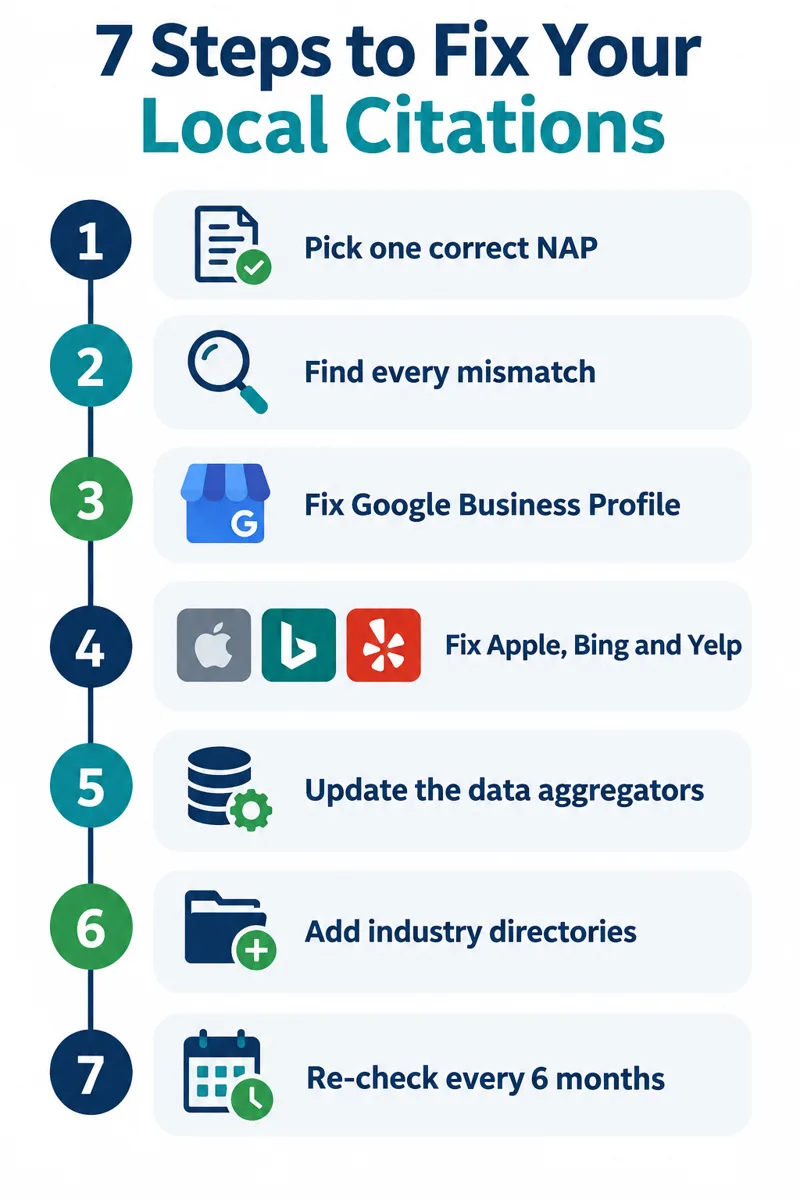
How to Build and Fix Local Citations in 7 Steps
Everything below comes back to your NAP: your business Name, Address and Phone number, written exactly the same way everywhere it appears online. Order matters here. Fix the sources everyone else copies from first, and most of the long tail corrects itself over the following weeks.
-
Decide on one correct version of your details. Write down your exact business name as it appears on your signage and legal paperwork, your street address with the suite number formatted one way, your main phone number, your website URL, and your hours. This is the version everything else must match.
In our experience, the search that finds the most problems for clients is an old phone number or a change in how the business name is written.
One of our clients, an IT support company called Be Structured, had its name spelled two different ways across the web: “BeStructured” on some listings, because the logo has no space between the words, and “Be Structured” on others, because every line of text on their website does.
After a meeting with the CEO, it was settled as two words, and our team spent a couple of weeks tracking down every directory, association page and IT-industry listing that had it wrong, then another two weeks waiting for the corrections to take effect. We can’t point to a specific lead that came from it, but using the same business name consistently helps search engines and AI platforms connect those listings to the same business.
-
Search for yourself and write down every mismatch.
Google your business name, then your old phone number, then your old address. Check Google Maps, Apple Maps, Bing, Yelp and Facebook by hand. You are looking for wrong numbers, old addresses, duplicate listings, and name variations. Most businesses find 5–15 problems in the first half hour.
-
Fix Google Business Profile first.
It is the listing Google trusts most and the one customers see first. If you haven’t claimed it, our guide to Google Business Profile instant verification walks through it. Make sure the name, address, phone and hours match the version from step 1 exactly, and follow Google’s guidelines for representing your business — no keywords stuffed into the business name, no P.O. boxes.
-
Fix the other three core listings: Apple Business Connect, Bing Places, and Yelp.
Apple feeds Siri and Apple Maps, Bing feeds Microsoft and Copilot, and Yelp’s data is syndicated to dozens of smaller sites. Claim each one, correct it, and remove any duplicates you find.
-
Submit your correct details to the data aggregators.
In the U.S., a small number of data companies — Data Axle, Foursquare, and Neustar Localeze are the big ones — supply business information to hundreds of directories, GPS systems and apps. Correcting your record with them is what stops the wrong version from being copied forward. This is the step most do-it-yourself efforts skip, and it is why the same wrong number keeps reappearing.
-
Add the directories that matter for your industry and your town.
The Better Business Bureau, your Chamber of Commerce, Nextdoor, and then the industry-specific sites: Avvo and Justia for law firms, Healthgrades and Zocdoc for medical practices, Houzz for contractors, and so on. Our list of free online business directories covers the general-purpose ones worth your time. Skip anything that asks you to pay for a basic listing unless it is the dominant directory in your field.
-
Re-check in 90 days, then twice a year.
Directories re-import data, well-meaning customers “suggest an edit” on Google, and old records resurface. Set a reminder. Search your old phone number again. If something has drifted, fix it at the source rather than on the individual site.
How many citations do you actually need?
Fewer than you’d think. The four core listings plus the aggregators plus a handful of industry directories — somewhere between 20 and 40 accurate citations — covers the vast majority of what Google checks for a single-location business. Two hundred listings on obscure directories with slightly different formatting will do more harm than 30 that match perfectly. Accuracy beats volume.
The Mistakes We See Most Often
After enough citation audits, the same handful of problems show up on almost every one. Beyond the misspelled or inconsistently written business name, these are the ones that catch businesses doing the work in-house:
- The suite number goes missing. Some directories have a second address line and some don’t, so the suite number ends up on half the listings and not the other half. A missing suite number can make it harder for customers and directories to identify the right office, especially in a shared building. Include every part of the address, every time, even if you have to put the suite number on the same line as the street.
- Abbreviations that look harmless. “Blvd.” on one site, “Boulevard” on another; “St.” here, “Street” there. Google tolerates a lot of this, but directories don’t always normalize it the way you’d expect, and the differences add up. Our rule is to spell everything out — Boulevard, Street, Avenue, Suite — on every listing, rather than assume an abbreviation will be recognized.
- A tracking phone number becomes the “official” number. A number set up for an ad campaign gets entered on a directory, that directory syndicates it, and a year later the campaign is over and the number is dead. Use a stable primary business number consistently across your core listings, and keep temporary campaign numbers out of syndicated business data. Call tracking can still be used when configured carefully, with a permanent local business number retained where the platform supports an additional number.
- Nobody keeps a log. If more than one person is submitting listings, or one person is doing it over several weeks, the details drift. Keep a single document with your name, address, phone, website and hours written exactly the way you want them to appear, and copy and paste from it into every platform. Never retype. This one habit prevents most of the problems above.
Citations and AI Search
There’s a newer reason to get this right. When someone asks ChatGPT, Perplexity or Google’s AI Mode for “a family law attorney near me” or “the best Thai restaurant in Fort Worth,” the answer is assembled from the same web data Google has always used — your business profile, review sites, directories, and your own website. AI assistants cross-check these sources against each other, and a business with three different phone numbers online is a business the model is less sure how to describe.
Clean, consistent citations are part of what makes your business “legible” to these systems. It is also one of the reasons citation and listing management sits inside Avita’s online reputation management services: what the directories say about you is part of what the AI says about you.
What a Citation Audit Looks Like
Before building anything, it helps to know how bad the problem is. A citation audit checks your business across the core listings, the aggregators and the top directories for your industry, and reports which ones are missing, which ones are wrong, and which ones are duplicated. It usually turns up a few surprises — a listing created by a former employee, a second Google profile at your old address, a Yelp page with the wrong category.
Avita includes a listings check in every free site audit, and it’s a standard line item in the paid version; our SEO audit pricing guide explains what’s covered at each tier. If the audit comes back clean, you don’t need us for this. If it comes back with fifteen mismatches, you’ll at least know what you’re fixing.
FAQs About Local Citation Building
Does this matter if I only have one location?
Yes, and in some ways it matters more. A multi-location chain has a corporate office keeping its data straight. A single-location business usually has one owner who set up a Google profile years ago and hasn’t checked the rest of the web since. Those are the businesses whose old phone numbers and pre-move addresses are still being copied between directories.
Should I pay a monthly service to keep my listings updated?
Some software companies sell a subscription that takes your business details once and pushes them out to dozens of directories automatically, then keeps them in sync for as long as you pay. That is useful if you have several locations or your hours and details change often. The catch is that the updates usually stop when the subscription does, and on some directories the old, wrong information comes back. If you have one location and the problem is a handful of outdated listings, a one-time cleanup you own outright is usually the better buy.
How long until fixing my listings helps my rankings?
The customer-facing benefit is immediate: the day a wrong phone number is corrected, the calls to that number stop going to the wrong place. The ranking benefit takes longer. Corrections at the data aggregators take four to eight weeks to propagate to the directories that copy from them, and Google needs to re-crawl those directories to notice. Most businesses see map-pack movement in the two-to-three-month range, assuming nothing else is holding them back.
Do I need to list my business on hundreds of directories?
No. For most single-location businesses, 20 to 40 accurate listings on the core platforms, the data aggregators, and the directories specific to your industry is plenty. Volume on low-quality directories does not help, and if the formatting varies from site to site it can hurt.
What counts as “inconsistent”? Does “St.” vs. “Street” really matter?
The big problems are a different phone number, a different street address, a suite number present on some listings and missing on others, a different business name (“Smith Law” vs. “Smith Law Group LLC”), and duplicate listings for the same location. Fix those first. Abbreviations like “St.” versus “Street” are a smaller issue — Google usually understands them — but in our experience it is safer to spell every word out on every listing than to assume each directory will treat them the same way. Pick one format, write it down, and copy it everywhere.
Can I just delete the wrong listings?
Sometimes. Most major platforms let a verified owner close a duplicate or mark a listing as moved. But many smaller directories don’t offer deletion at all, and deleting a listing you could have corrected throws away whatever trust that site had already built. Correct first, delete duplicates second, and only abandon a listing when the site offers no way to fix it.
Get Your Listings Right Once
Local citation building is unglamorous. Nobody will compliment you on it. But a business whose name, address and phone number match everywhere online is a business Google can confidently show in the map, an AI assistant can confidently recommend, and a customer can actually reach. If you’d rather not spend a weekend on it, Avita’s search engine optimization services include a one-time listings cleanup, done by hand, in accounts you own. Start with the free audit and see what it turns up.