
Click on the Play Button to hear a podcast of this blog.
Thanks to the whiplash of AI, the online search landscape is changing…fast.
Today, millions of people are getting their answers directly from AI tools like ChatGPT, Claude, and Perplexity instead of clicking through traditional search results.
If your business isn’t showing up in these AI-generated responses, you’re invisible to a growing segment of your potential customers.
And believe us, this segment will continue to grow at breakneck speed. In fact, AI search traffic grew 527% in 2025 versus the previous year, and that number is estimated to grow at a similar if not higher rate in 2026.
At Avita Group, we have passionately embraced the AI revolution and evolution, by implementing the latest AI optimization tips and tricks of how to rank in AI searches, and our clients have appreciated the progress.
Because the nature of AI search tends to be more conversational than the organic spares keyword strategy, we have adopted page crafting tactics that address more question and answer strategies than ever before.
But it’s one thing to make your content AI friendly, but how can you track the strategies to assure they are working?
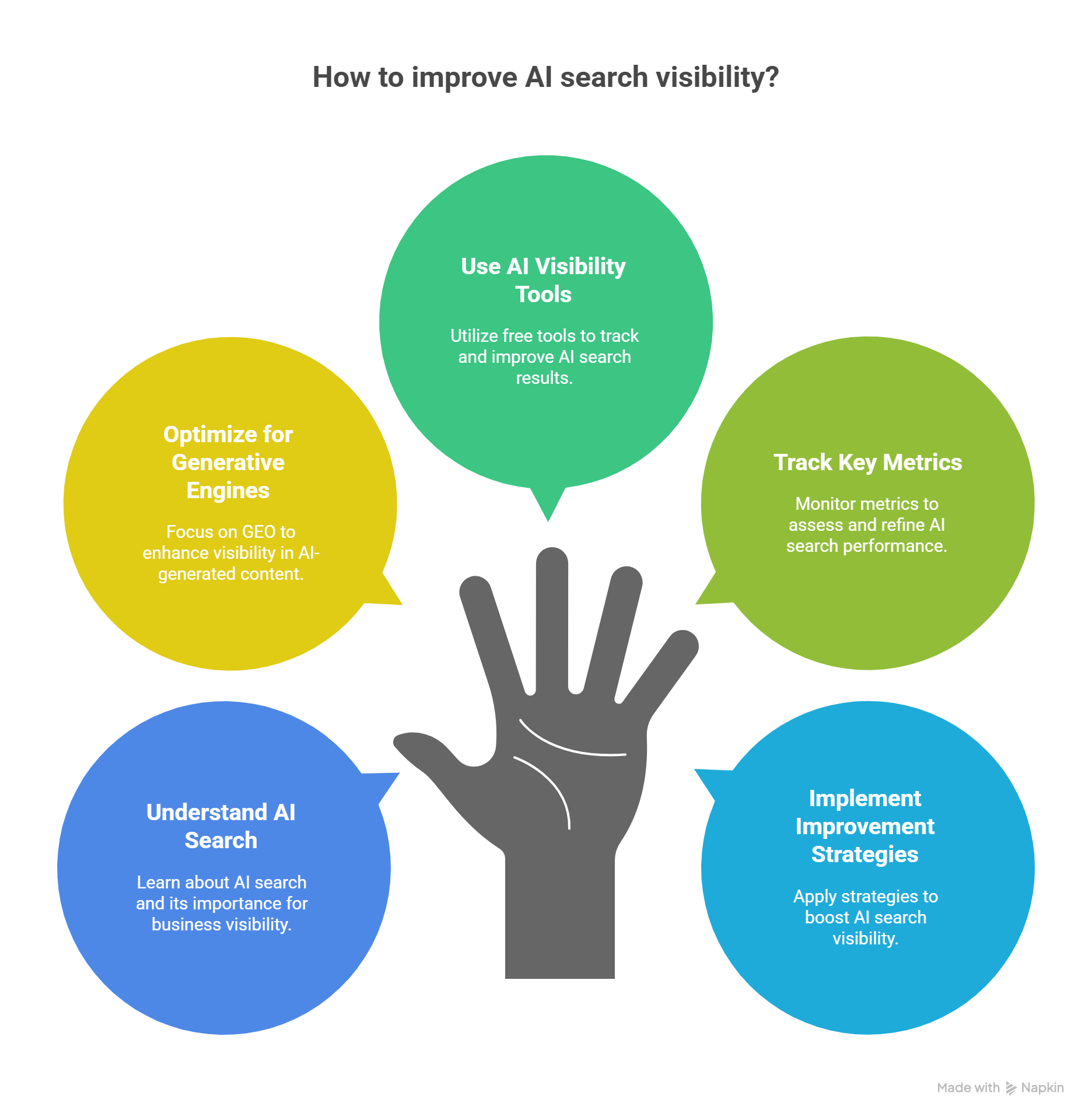
Let’s walk through the ways to most accurately track whether your business appears in AI search results with the help of the best software for ai visibility in search—and what you can do to improve your visibility with an eye on:
- What Is AI Search Visibility and Why Does It Matter?
- Understanding Generative Engine Optimization (GEO)
- Best AI Search Visibility Tools (Free Methods)
- Key Metrics to Track for AI Search Visibility
- How to Improve Your AI Search Visibility
No technical background required. We promise.
What Is AI Search Visibility and Why Does It Matter?
AI search visibility refers to how often and prominently your brand, products, or content appear when someone asks an AI tool a question related to your business. This includes platforms like ChatGPT, Google’s AI Overviews (formerly called SGE), Perplexity, Claude, Microsoft Copilot, and Gemini.
According to Search Engine Land, AI search fundamentally changes how people discover information.
Instead of showing you a list of links, AI tools synthesize information from multiple sources and provide direct answers. The goal for businesses has shifted from ranking high in a list of links to being the trusted source that AI cites when answering questions.
Key Insight: Traditional SEO metrics like keyword rankings and click-through rates don’t tell the full story anymore. You could rank #1 in Google and still be invisible in AI-generated answers. That’s why tracking AI search visibility requires a new approach.
Understanding Generative Engine Optimization (GEO)
Before diving into tracking methods, it’s important to understand the emerging field that addresses AI search visibility: Generative Engine Optimization, or GEO.
GEO is the practice of adapting digital content and online presence to improve visibility in results produced by generative AI systems.
The term was introduced by researchers at Princeton University in late 2023, and it has quickly become a standard part of digital marketing strategy. While traditional SEO focuses on ranking in Google’s search results, GEO focuses on being cited, referenced, and recommended by AI platforms.
How GEO differs from traditional SEO:
| Traditional SEO | Generative Engine Optimization (GEO) |
| Optimize for keyword matching | Optimize for natural language understanding |
| Focus on ranking in search results pages | Focus on being cited in AI-generated answers |
| Measure success by clicks and traffic | Measure success by mentions and citations |
| Target short-tail keywords | Target conversational, long-tail queries |
| Build backlinks for authority | Build topical authority and E-E-A-T signals |
Best AI Search Visibility Tools (Free Methods)
You don’t need expensive tools to start understanding your AI visibility. Here are practical, free methods any business owner can use today.
1. Manual Testing Across AI Platforms
The simplest way to check your AI visibility is to ask the questions your customers would ask and see if your business appears in the answers.
Action Step: Create a list of 10-15 questions your ideal customers might ask AI tools about your industry, products, or services. Then systematically ask these questions on ChatGPT, Perplexity, Google’s AI Mode, and Microsoft Copilot. Document which platforms mention your business.
Example questions for a digital marketing agency might include:
- “What are the best digital marketing agencies in [your city]?”
- “How do I choose an SEO company for my small business?”
- “What should I look for in a PPC management service?”
- “Who are the top-rated marketing agencies for [your industry]?”
2. Monitor Google AI Overviews
Google’s AI Overviews appear at the top of many search results, providing AI-generated summaries before the traditional blue links.
To track your presence:
- Search for your target keywords on Google and note whether AI Overviews appear
- Check if your website is cited in the AI Overview sources
- Document which competitors are being cited instead
- Use incognito mode to avoid personalized results skewing your data
3. Use Free AI Visibility Checkers
Several platforms now offer free tools to check your AI search visibility. Semrush’s free AI Visibility Checker lets you see how your brand appears across AI platforms by analyzing responses to industry-relevant prompts.
Other free options include:
- Am I On AI – Quick check if your brand appears in AI answers
- ZipTie – Basic visibility checks across major AI platforms
4. Track AI-Driven Traffic in Google Analytics
Here’s something many businesses don’t realize: traffic from AI tools often shows up as “Direct” or “Unassigned” in Google Analytics 4 (GA4) because these platforms don’t always pass referral information. If you’ve noticed a significant increase in direct traffic recently, some of it may actually be coming from AI search.
Pro Tip: Look for patterns in your GA4 data. A spike in direct traffic combined with increased engagement metrics (time on site, pages per session) could indicate AI-driven visitors who are highly qualified and ready to take action.
Key Metrics to Track for AI Search Visibility
Knowing what to measure is just as important as having the tools to measure it.
Here are the essential metrics:
- Brand Mentions – How often is your brand name mentioned when AI tools respond to relevant queries?
- Citations – When AI platforms cite sources, is your website among them?
- Sentiment – How is your brand described when it appears? Positive, negative, or neutral?
- Share of Voice – Compared to competitors, how often do you appear for target queries?
- Query Coverage – Which types of questions generate mentions of your brand?

People using AI platforms for search results grew almost 530% in 2025. That number could double in 2026.
How to Improve Your AI Search Visibility
Tracking is only valuable if you take action on what you learn. Here are proven strategies to improve your AI visibility.
1. Create Authoritative, Comprehensive Content
AI models prioritize content that demonstrates Experience, Expertise, Authoritativeness, and Trustworthiness (E-E-A-T).
According to HubSpot’s research, AI queries average 23 words compared to Google’s 4-word average. This means users are asking more specific, conversational questions—and your content needs to answer them comprehensively.
What this means in practice:
- Include specific statistics, data, and citations in your content
- Attribute information to credible sources and experts
- Create comprehensive guides that fully answer user questions
- Include author bios with credentials and expertise
- Keep content updated with visible “last updated” dates
2. Optimize Your Online Presence Beyond Your Website
AI models don’t just look at your website—they synthesize information from across the internet. This makes your presence on directories, review sites, and social platforms critically important.
- Claim and optimize your Google Business Profile – This is foundational for local visibility
- List your business in quality free online directories – Essential platforms for building authority
- Generate and respond to reviews – AI models consider reputation signals
- Maintain consistent NAP information – Name, address, phone should be identical across all platforms
3. Structure Content for AI Comprehension
AI models process your content differently than humans do. Help them understand and cite your content by:
- Using clear heading hierarchies (H1, H2, H3) that organize information logically
- Including FAQ sections that directly answer common questions
- Adding schema markup (FAQ schema, How-To schema, Article schema)
- Writing clear, concise summaries at the beginning of articles
- Using bullet points and tables for complex information
Need Help With Your AI Search Strategy?
At Avita Group, we’re at the forefront of AI search optimization. Our team tracks AI citations across every AI platform as part of our comprehensive digital marketing services.
Contact us for a free consultation: avitagroup.com/contact
Avita Group – AI Digital Marketing Agency in Los Angeles
Avita Group is a long-tenured digital marketing company in Calabasas, California. Our clients often have had previous agency experiences and ultimately find a long-term home with Avita Group.
We offer fractional CMO services to boost your brand and your business by maximizing your SEO and PPC management, online reputation services, and using the best AI tools for business.
The Avita Group team boasts a collective experience of over 30 years in the industry led by Founder and CEO, Brad Weber, and has worked with a variety of multi-million dollar companies to help them improve their ROI, build better brand awareness, and mitigate negative online reviews.