
For over 30 years, Avita Group has helped businesses protect and enhance their online reputations, but with the advent of artificial intelligence, AI reputation management has become a primary consideration for companies looking to protect their brand.
Today, when someone asks ChatGPT or sees Google’s AI Overviews summarizing information about a company, they’re forming opinions about your brand before they ever visit your website. And that is, if they ever visit your website.
This is why AI reputation management has become essential for every business that wants to remain competitive in 2026 and beyond.
In this comprehensive guide, we’ll show you exactly how to monitor what AI platforms are saying about your brand, which tools can help track your AI brand mentions, and practical strategies for LLM (Large Language Model) brand monitoring that you can implement today.
Let’s address:
- Why AI Reputation Management Matters in 2026
- Traditional Reputation Management vs. AI Reputation Management
- The AI Platforms You Need to Monitor
- Top 3 Tools for LLM Brand Monitoring
- Manual Reputation Monitoring Strategies (No Tools Required)
- Building Your AI Reputation Strategy
- Key Metrics for AI Reputation Management
- The Future of Brand Visibility Is AI-Driven
- Related Reputation Management Resources
Why AI Reputation Management Matters in 2026
The numbers tell a compelling story. ChatGPT now has 800 million weekly active users and processes approximately 29,00 prompts per second. These numbers that are on track to rival Google’s search volume by 2027.
Meanwhile, Google’s AI Overviews now appear in 60% of all search results in the United States, up from just 25% in August 2024.
What does this mean for your brand?
The implication is clear: if your brand isn’t being mentioned accurately (or at all) in AI-generated responses, you’re losing ground to competitors who are.
Traditional online reputation management focused on search results and review sites is no longer sufficient.
Traditional Reputation Management vs. AI Reputation Management
As experts in reputation management strategy, Avita group has observed that traditional ORM and AI reputation management serve complementary but distinct purposes.
Traditional ORM focuses on:
- Monitoring and responding to reviews on Google, Yelp, and industry-specific platforms
- Managing social media mentions and sentiment
- Creating positive content to outrank negative search results
- Tracking branded keyword rankings in traditional search
AI reputation management adds:
- Tracking how often your brand is mentioned in ChatGPT, Perplexity, and Gemini responses
- Monitoring citation frequency in Google AI Overviews and AI Mode
- Analyzing sentiment and accuracy of AI-generated brand descriptions
- Measuring Share of Voice against competitors across AI platforms
- Identifying which of your pages are being cited as sources
The AI Platforms You Need to Monitor
Not all AI platforms work the same way. Understanding their differences helps you prioritize your monitoring efforts and optimize your content for each.
- ChatGPT (OpenAI)
With 800 million weekly active users and 81% market share, ChatGPT is the most important AI platform for brand monitoring.
- Google AI Overviews and AI Mode
Google AI Overviews reach 1.5 billion users monthly and now appear in 50-60% of U.S. searches.
- Perplexity AI
It’s particularly valuable for B2B audiences and technical niches because it emphasizes factual accuracy and source citation.
- Microsoft Copilot
Integrated across Microsoft 365 products, reaching enterprise users.
- Claude (Anthropic)
Growing in technical and professional use cases.

Using AI to keep tabs on your reputation management can save you time to preserve your brand
Top 3 Tools for LLM Brand Monitoring
Just as we recommend specific tools for traditional online reputation management, a new category of AI visibility tracking tools has emerged to help brands monitor their presence across LLMs.
Here are the leading options we’ve evaluated (most offer free trials and then prices vary ongoing):
1. Otterly.AI
Otterly.AI is an award-winning platform trusted by over 15,000 marketing professionals worldwide.
Key Features:
- Monitors brand mentions across ChatGPT, Google AI Overviews, Perplexity, Gemini, Copilot, and AI Mode
- Tracks citation links and URL positions weekly
- Provides Brand Visibility Index and Share of Voice metrics
- Offers GEO (Generative Engine Optimization) Audit tools
- Includes AI keyword research for prompt discovery
2. Ahrefs
Their new Brand Radar feature allows you to see what search queries you’re ranking for and what the competitors are ranking for above you.
Key Features:
- Tracks brand visibility and sentiment across major AI search engines
- Supports 115+ languages for international brand monitoring
- Offers regional and multi-country tracking breakdowns
- Clean, modern interface with prompt-level reporting
- Unlimited team seats on all plans
3. Semrush AI Visibility Toolkit
For teams already using Semrush for SEO, their AI Visibility Toolkit provides integrated LLM tracking without requiring a separate platform.
Key Features:
- Tracks visibility across ChatGPT, Google AI Overviews, Gemini, Claude, Grok, Perplexity, and DeepSeek
- Competitor Rankings and Market Analysis dashboards
- Integrated with existing Semrush SEO data
- Citation and source-level analysis
Manual Reputation Monitoring Strategies (No Tools Required)
If you’re not ready to invest in dedicated LLM tracking tools, you can begin monitoring your AI visibility manually. This approach takes more time but provides valuable baseline insights.
Step 1: Create Your Prompt Library
Build a list of 10-20 prompts that your potential customers might ask AI assistants. Mix branded and category queries:
- “What is the best [your product category] for [use case]?”
- “Compare [your brand] vs [competitor]”
- “What do people say about [your brand]?”
- “Top [your industry] companies in [location]”
- “Is [your brand] trustworthy/reliable/recommended?”
Step 2: Test Across Platforms
Enter your prompts into ChatGPT, Perplexity, and perform Google searches to see AI Overviews. Document which platforms mention your brand, whether the information is accurate, and which competitors appear in the same responses.
Note that AI responses vary by session, so test multiple times for consistency.
Step 3: Track AI Referral Traffic
In Google Analytics 4, monitor your traffic sources for AI referrals. Look for traffic from chatgpt.com, chat.openai.com, perplexity.ai, and similar domains. As we’ve discussed in our blog about how AI is changing digital marketing, significant increases in “direct” or “unassigned” traffic may also indicate AI-driven discovery that GA4 struggles to attribute properly.
Step 4: Create a Tracking Spreadsheet
Record your findings in a simple spreadsheet with columns for:
- Date tested
- Prompt used
- Platform (ChatGPT, Perplexity, Google AIO)
- Brand mentioned? (Yes/No)
- Position in response (1st, 2nd, etc.)
- Sentiment (Positive/Neutral/Negative)
- Accuracy (Correct/Outdated/Incorrect)
- Competitors mentioned
Building Your AI Reputation Strategy
Monitoring is only the first step.
Once you understand how your brand appears in AI search, you need a strategy to improve your visibility.
Based on our decades of experience in reputation management and our analysis of how AI systems source information, here are the key tactics:
Create Citation-Worthy Content
Research shows that LLMs rely heavily on editorial content — more than half of brand reputation understanding comes from third-party content rather than your own website. Focus on:
- Comprehensive guides and how-to content with clear, factual information
- Comparison pages and listicles
- Content with current statistics and data (AI platforms prefer “fresher” content than traditional search)
- FAQ sections that directly answer common questions in conversational language
Build Third-Party Mentions
Brands are more likely to be cited through third-party sources than their own domains. Prioritize:
- Wikipedia presence
- Reddit discussions in relevant communities
- YouTube content (cited heavily by Google AI Overviews)
- Industry publications and authoritative review sites
- LinkedIn professional content (important for Google AI citations)
Address Misinformation Quickly
Just as we’ve advised clients on protecting reputations on social platforms, inaccurate information in AI responses requires swift action.
If ChatGPT or other platforms are sharing outdated or incorrect information about your brand, update your website content with correct details, ensure your Wikipedia entry (if you have one) is accurate, and create fresh content that addresses the misinformation directly.
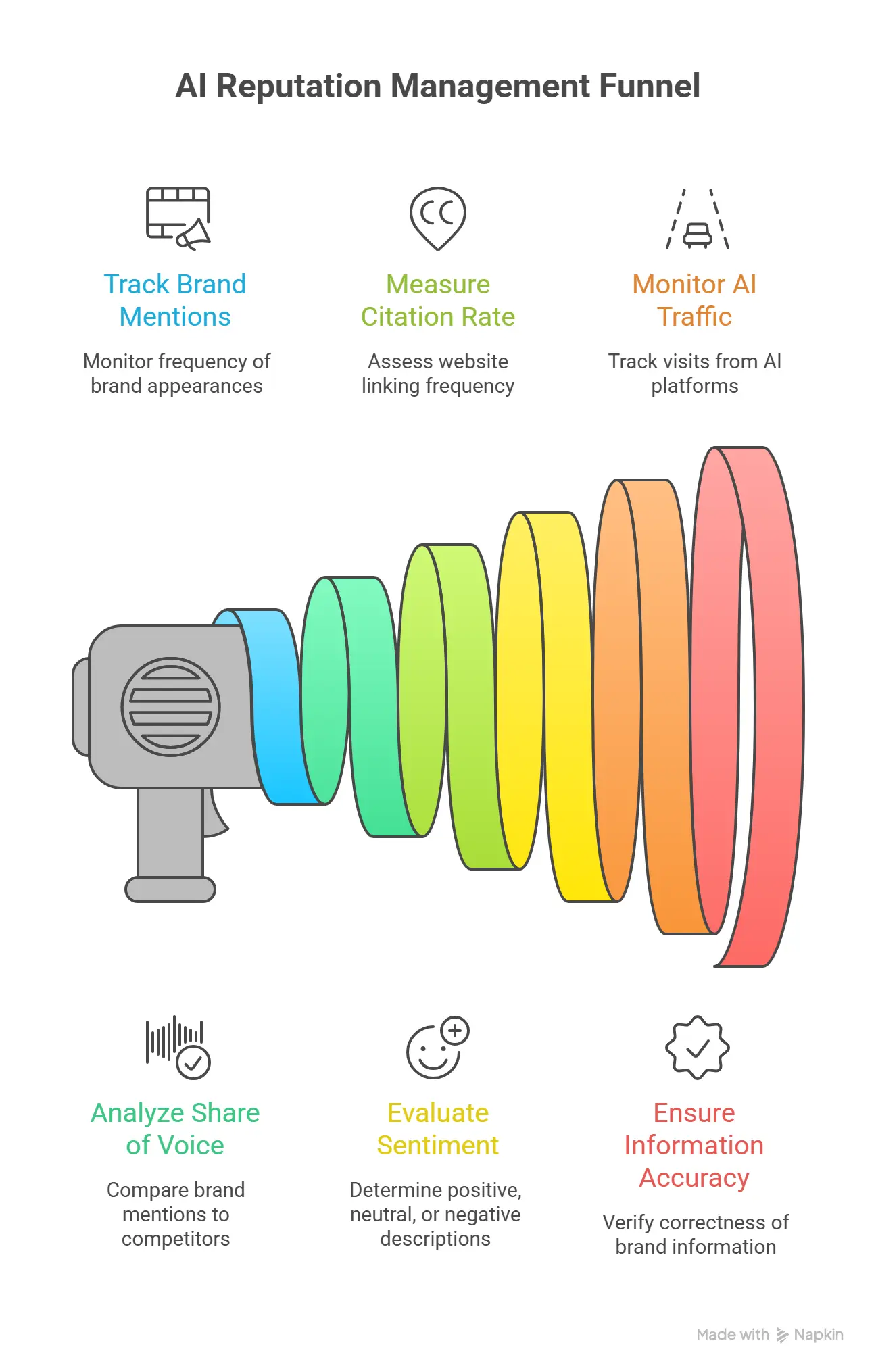
11 Key Metrics for AI Reputation Management
To measure your AI reputation management success, track these KPIs:
- Brand Mention Frequency: How often your brand appears in AI responses to relevant queries
- Share of Voice: Your percentage of mentions compared to competitors in the same category
- Citation Rate: How frequently your website pages are linked as sources
- Sentiment Analysis: Whether AI platforms describe your brand positively, neutrally, or negatively
- AI Referral Traffic: Visits from AI platforms tracked in your analytics
- Information Accuracy: Percentage of AI responses containing correct, current information about your brand
- Audit your current AI visibility by testing 10-15 relevant prompts across ChatGPT, Perplexity, and Google
- Document your baseline including brand mentions, competitors mentioned, and accuracy of information
- Set up GA4 tracking for AI referral sources and monitor changes monthly
- Evaluate LLM tracking tools based on your budget and the platforms most important to your audience
- Create a content optimization plan focused on citation-worthy content, third-party presence, and accurate brand information
The Future of Brand Visibility Is AI-Driven
The shift from traditional search to AI-assisted discovery isn’t coming—it’s already here. Your brand’s visibility in AI responses has become as critical as your organic Google rankings once were.
At Avita Group, we’ve spent three decades helping businesses navigate every major shift in digital marketing—from the early days of search engines to the social media explosion to the current AI revolution.
The fundamentals of reputation management remain the same: monitor what’s being said, ensure information is accurate, and proactively build positive visibility. Only now, those principles must extend beyond search results and review sites to include ChatGPT, Perplexity, Google AI Overviews, and the next generation of AI platforms.
The brands that adapt quickly will own this new frontier of digital visibility. Those that wait risk becoming invisible in the conversations that increasingly shape consumer decisions.
Need help developing your AI reputation management strategy?
Our team combines decades of reputation management expertise with cutting-edge knowledge of AI search optimization.
Related Reputation Management Resources
Explore more reputation management insights from Avita Group:
- Online Reputation Management Services
- Best Tools for Online Reputation Management
- How to Protect Your Online Reputation on Social Platforms
- Why Is Online Reputation Management Important?
- Best Free AI Tools to Improve Your Website
- How Artificial Intelligence Is Changing Digital Marketing
Avita Group – AI Digital Marketing Agency in Los Angeles
Avita Group is a long-tenured digital marketing company in Calabasas, California. Our clients often have had previous agency experiences and ultimately find a long-term home with Avita Group.
We offer fractional CMO services to boost your brand and your business by maximizing your SEO and PPC management, online reputation services, and using the best AI tools for business.
The Avita Group team boasts a collective experience of over 30 years in the industry led by Founder and CEO, Brad Weber, and has worked with a variety of multi-million dollar companies to help them improve their ROI, build better brand awareness, and mitigate negative online reviews.
Contact us for a free consultation to evaluate how we can transform and elevate your business.